



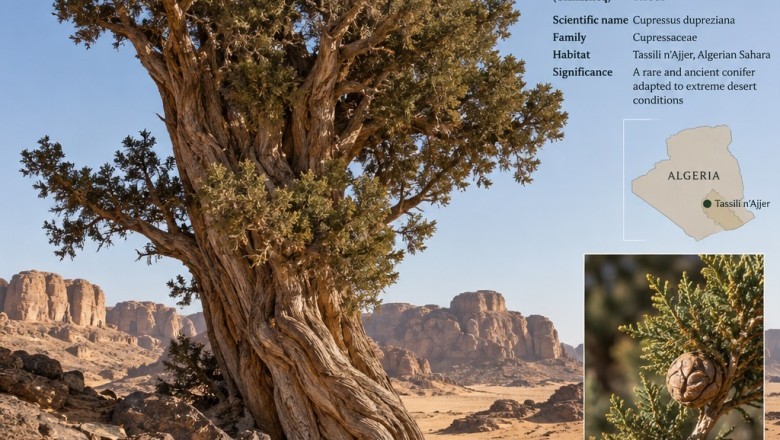

Discover the remarkable history of the Tassili Cypress (Tarout), an ancient, critically endangered tree in Algeria’s Sahara Desert that has survived for over 2,000 years as a living witness to the prehistoric Green Sahara.
Ghosts of the Green Sahara: The Two-Thousand-Year History of the Tassili Cypress
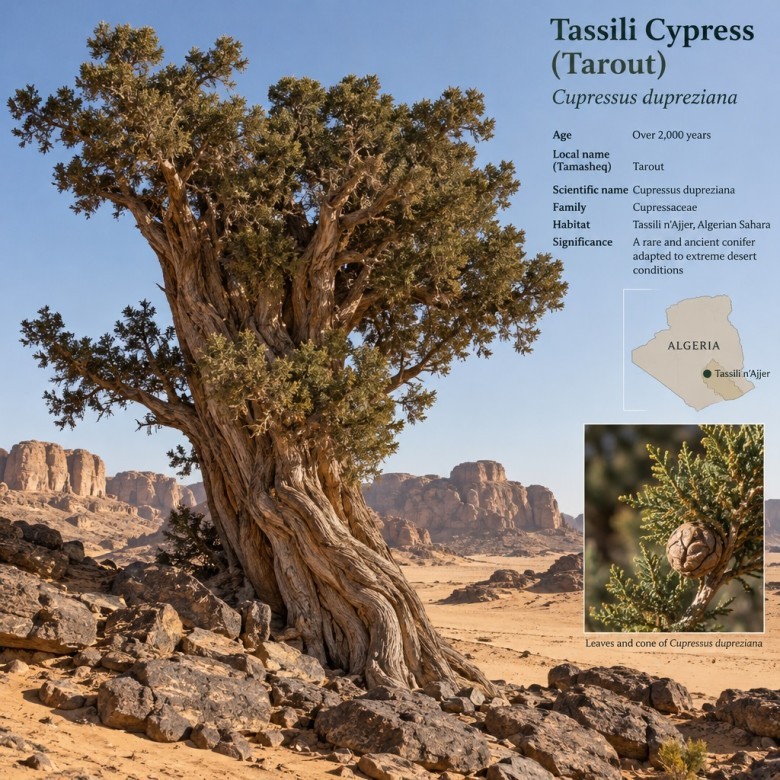
High upon the wind-scoured sandstone plateaus of southeastern Algeria, in a land where rain is an event so rare it is measured in decades rather than seasons, stands a tree that should not exist.
Its trunk, twisted like ancient rope and bleached silver-grey by millennia of relentless sun, clings to the rocky beds of dry riverbeds known as wadis. Around it stretches the hyper-arid expanse of the Tassili n'Ajjer mountains—a lunar landscape of sandstone towers, shifting dunes, and silence. Yet, crowning its gnarled limbs is a canopy of deep, resilient green.
To the indigenous Tuareg people, this tree is known in the Tamasheq language as the Tarout. To botanists and historians, it is Cupressus dupreziana—the Tassili Cypress. With fewer than 240 individuals remaining in the wild and many standing for over two millennia, the Tarout is far more than a botanical anomaly. It is a living time capsule, the final biological witness to a vanished world when the Sahara Desert was a lush, green paradise.
Echoes of a Green Sahara
To understand the history of the Tassili Cypress, one must look back roughly 10,000 years to the African Humid Period. During this era, shifts in the Earth’s orbit brought heavy monsoon rains deep into North Africa. Where there is now lifeless sand, vast lakes shimmered, rivers carved deep canyons through the Tassili massif, and lush Mediterranean forests blanketed the highlands.
During this "Green Sahara," ancestors of the Tassili Cypress thrived alongside olive trees, oaks, and pines. Beneath their shade roamed elephants, giraffes, hippopotamuses, and early human pastoralists who left behind one of the world’s richest collections of prehistoric rock art on the surrounding sandstone cliffs.
Around 5,000 years ago, the climate began a dramatic, irreversible shift. The monsoons retreated south, the rivers dried into dusty wadis, and the great Sahara Desert was born. As the forest perished, a tiny, isolated pocket of cypress trees high in the Tassili n'Ajjer plateau—at elevations between 1,400 and 1,800 meters—managed to hold on. Cut off from their Mediterranean cousins by hundreds of miles of impassable sand, these survivors evolved in total isolation, becoming a distinct species uniquely adapted to survive on as little as 30 millimeters of rainfall per year.
The Silent Witnesses of Antiquity
The oldest surviving Tarout trees standing today—such as the famed giant known as Tin-Balalan, which boasts a trunk circumference of twelve meters—took root over 2,000 years ago.
While Rome was transitioning from a Republic to an Empire, and while the Garamantes civilization was building complex underground irrigation networks across the Saharan interior, these trees were already young saplings drinking from the lingering moisture beneath the Tassili gravel. Over the centuries, they stood silent as trans-Saharan camel caravans laden with gold, salt, and ivory passed through the mountain passes below.
Because there were so few of them, and because each possessed such a distinct, weathered silhouette, the nomadic Tuareg never viewed the Tarout as a mere forest. Instead, they treated them as landmarks and elders, giving individual trees personal names such as "The One by the Flat Stones". For centuries, local Tuareg custom strictly forbade cutting down living Tarout trees, recognizing their sacred permanence in a shifting world, though deadwood was prized for crafting durable saddles and tools.
A Botanical Mystery Unraveled
For centuries, the existence of a conifer forest in the heart of the central Sahara was little more than a rumor to the outside world. In 1860, the English explorer Henry Baker Tristram examined the dense, fragrant, resinous wood used in Tuareg camel saddles and deduced that a species related to the juniper or cypress must be hiding somewhere in the unexplored interior.
It was not until 1925 that science finally laid eyes on the tree. During a French expedition crossing the Tassili range between Ghat and Djanet, forestry inspector Louis Lavauden collected fragmentary branches and small, rounded cones from the mysterious trees. A year later, French botanist Aimée Antoinette Camus officially classified the species, naming it Cupressus dupreziana in honor of Captain Duprez, the French military commander stationed at Djanet.
Later scientific study revealed that the Tarout held a reproductive secret unlike any other conifer on Earth. Facing extreme isolation and a lack of viable mates, the Tassili Cypress evolved a rare biological mechanism known as male apomixis. In an extraordinary evolutionary workaround, a grain of pollen lands on a female cone and develops into an embryo entirely on its own, without combining genetic material from the mother tree. In essence, the female tree acts purely as a surrogate, allowing male trees to clone themselves through seeds—a desperate, brilliant strategy to cheat extinction in an unforgiving desert.
A Fragile Legacy
Despite surviving two millennia of climate change, the modern era has brought the Tassili Cypress to the brink. In the 19th and early 20th centuries, before the establishment of Tassili n'Ajjer National Park, European explorers and colonial troops felled several ancient trees for firewood and timber.
Today, the remaining population of just over 200 trees faces an even quieter threat: the total absence of natural regeneration. While the ancient trees still produce cones, the desert floor is now too parched for seeds to germinate, and any rare sprout that emerges is quickly devoured by grazing goats or trampled. Combined with intensifying droughts that have claimed dozens of the oldest specimens in recent years, the wild population is slowly aging out.
Conservationists in Algeria and botanical gardens around the world are now racing to preserve the Tarout's genetic lineage through nurseries and off-site plantings. Yet, nothing can truly replicate the majesty of the originals in their native stone sanctuary. Standing against the red cliffs of Tassili n'Ajjer, the Tarout remains a profound monument to resilience—a living bridge connecting human history to the deep, forgotten memory of a green Sahara.














Comments
0 comment